
Symptom Guide
Air Conditioner Not Cooling
An air conditioner that runs without cooling is one of the most common calls in Central Florida. The causes range from a thermostat setting to a failed compressor, and a short sequence of observations narrows the field quickly.
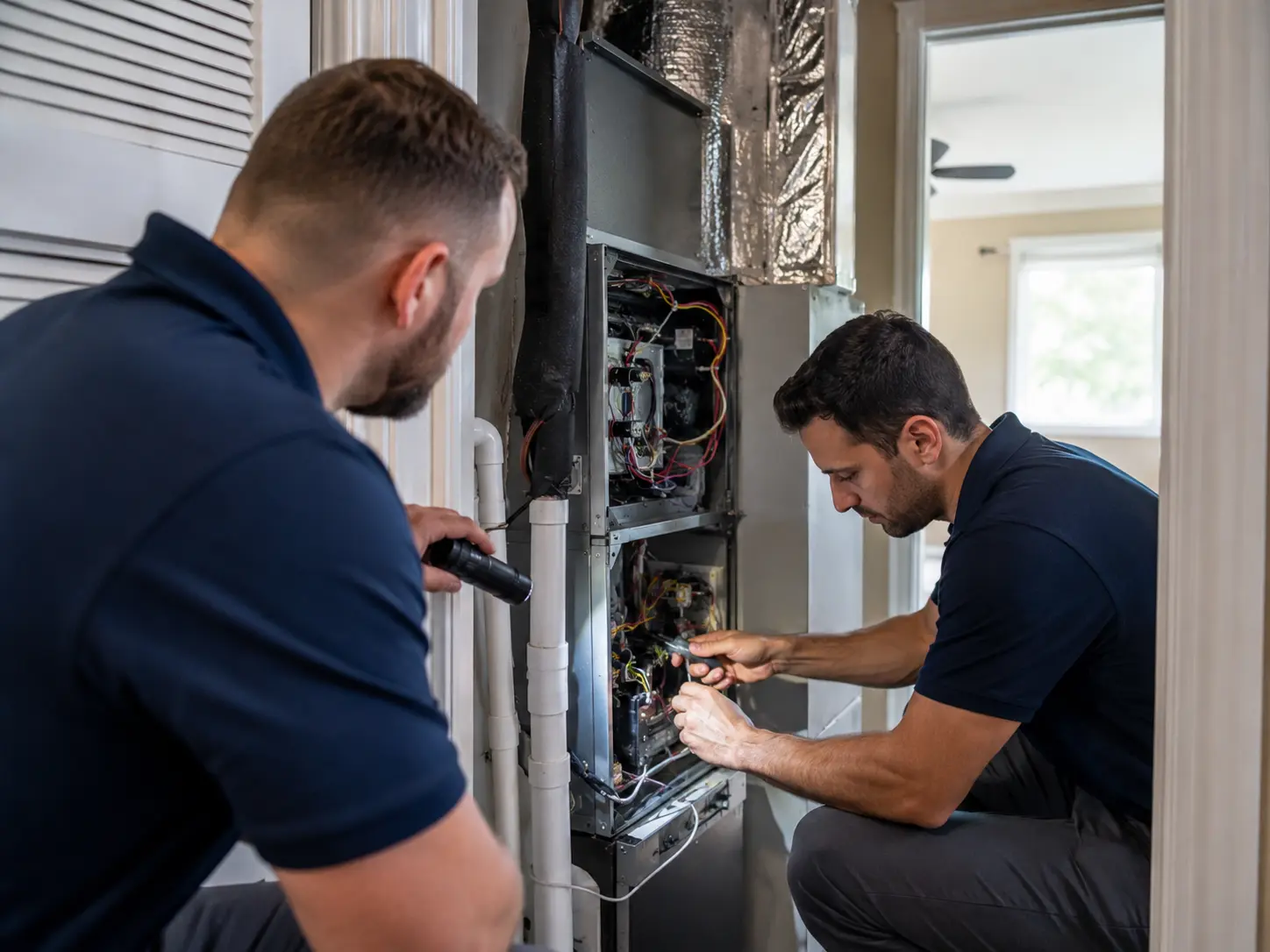
Start by Separating the Two Halves
A cooling system has an indoor half and an outdoor half. Determining which one is not doing its job eliminates most of the possibilities immediately.
Go outside and listen. If the outdoor unit is silent while the indoor blower runs, the problem is on the outdoor side: electrical components, controls, or the compressor circuit. If both run and the air is still not cold, the focus moves to refrigerant charge, coil condition, and airflow.
If nothing runs at all, including the indoor blower, look at control power: thermostat batteries, a tripped breaker, a blown low-voltage fuse, or a condensate float switch holding the system off.
The Most Common Causes
Ranked roughly by how often they turn up in Orlando homes, these account for the large majority of no-cooling calls.
- A loaded air filter restricting airflow across the evaporator coil
- A failed run capacitor preventing the compressor or fan from starting
- A tripped condensate float switch from a blocked drain line
- Low refrigerant charge caused by a leak in the sealed circuit
- A frozen evaporator coil blocking airflow entirely
- A burned or stuck contactor in the outdoor unit
- A thermostat problem, wiring fault, or configuration error
- A dirty condenser coil unable to reject heat outdoors
- A failed condenser fan motor causing high-pressure shutdowns
- Compressor failure, the least common but most expensive outcome
Safe Checks You Can Make
None of these require removing panels or working near line voltage, and each one either resolves the problem or gives a technician useful information.
- Confirm cool mode and a setpoint several degrees below current room temperature
- Replace thermostat batteries if the display is dim or blank
- Inspect the air filter and replace it if it is visibly loaded
- Check the breaker panel for a tripped breaker and reset it once only
- Look for ice on the refrigerant lines or indoor coil
- Check for standing water in the drain pan or around the air handler
- Verify the outdoor unit has clearance and is not blocked by vegetation
- Confirm all supply registers and return grilles are open and unobstructed
A Step-by-Step Sequence Before You Call
Working through the checks in the same order a technician does gives you information that shortens the visit, and it occasionally resolves the problem outright.
- Confirm the call for cooling: thermostat powered, set to cool, setpoint below room temperature.
- Observe what is running: blower only, both halves, or nothing at all.
- Check airflow: filter condition, open supply registers, unobstructed return grilles.
- Look for ice on the suction line or coil, and for water in or around the drain pan.
- Inspect the outdoor unit from a safe distance for a stalled fan, a fouled coil, or crowded vegetation.
- Note the cycling pattern: how long it runs, and whether it stops on its own.
When It Cools, Just Not Enough
Partial cooling is a different problem from no cooling. If the system keeps up in the morning and falls behind by afternoon, it is running near the edge of its capacity, and the usual contributors are charge, coil fouling, airflow restriction, or duct losses in a hot attic.
Measuring the temperature difference between return and supply air is the standard next step. A split well below the expected range points at charge or airflow; a normal split with poor comfort points toward distribution, duct leakage, or load.
What Remains Requires Instruments
Beyond the homeowner checks, diagnosis needs gauges, meters, and airflow measurement: refrigerant pressures, superheat and subcooling, capacitor microfarads, motor amperage, and static pressure. Those measurements are what separate a confirmed diagnosis from a guess.
Do not remove panels or attempt to spin the outdoor fan. Capacitors store energy after power is disconnected, and pulling the disconnect does not make the interior safe without training.
Answers
Frequently Asked Questions
Why is my AC running but not cooling the house?
The blower can run independently of the cooling cycle. If the outdoor unit is not operating, or if charge, coil condition, or airflow are wrong, you get air movement without heat removal.
How cold should the air from my vents be?
A properly operating system typically delivers supply air noticeably cooler than return air, commonly in the high teens to low twenties of degrees Fahrenheit difference. Humidity and duct conditions affect what you feel at the register.
Can a dirty filter really stop cooling?
Yes. Severe restriction lowers airflow enough to freeze the coil, and once ice blocks the coil, cooling stops entirely.
My AC worked yesterday and not today. What changed?
Sudden failures point toward electrical components, a tripped safety, or a drain blockage rather than gradual issues such as a slow refrigerant leak.
Why does my AC cool at night but not during the day?
That pattern indicates the system is near its capacity limit. Charge, coil fouling, airflow restriction, or duct losses in a hot attic are the usual contributors.
Should I turn the temperature way down to catch up?
It will not make the system cool faster. The equipment runs at the same capacity; a very low setpoint only extends run time and can encourage freezing when something is already wrong.
Related Pages
Discuss Your AC Problem
Describe what your system is doing and get repair information for your Orlando home.