Core Service
AC Repair in Orlando, FL
Air conditioning repair covers everything from a failed capacitor on a summer afternoon to a system that has been slowly losing capacity for months. This page explains how a cooling problem is diagnosed, which components fail most often in Central Florida, and what to expect from a repair visit.
What AC Repair Actually Involves
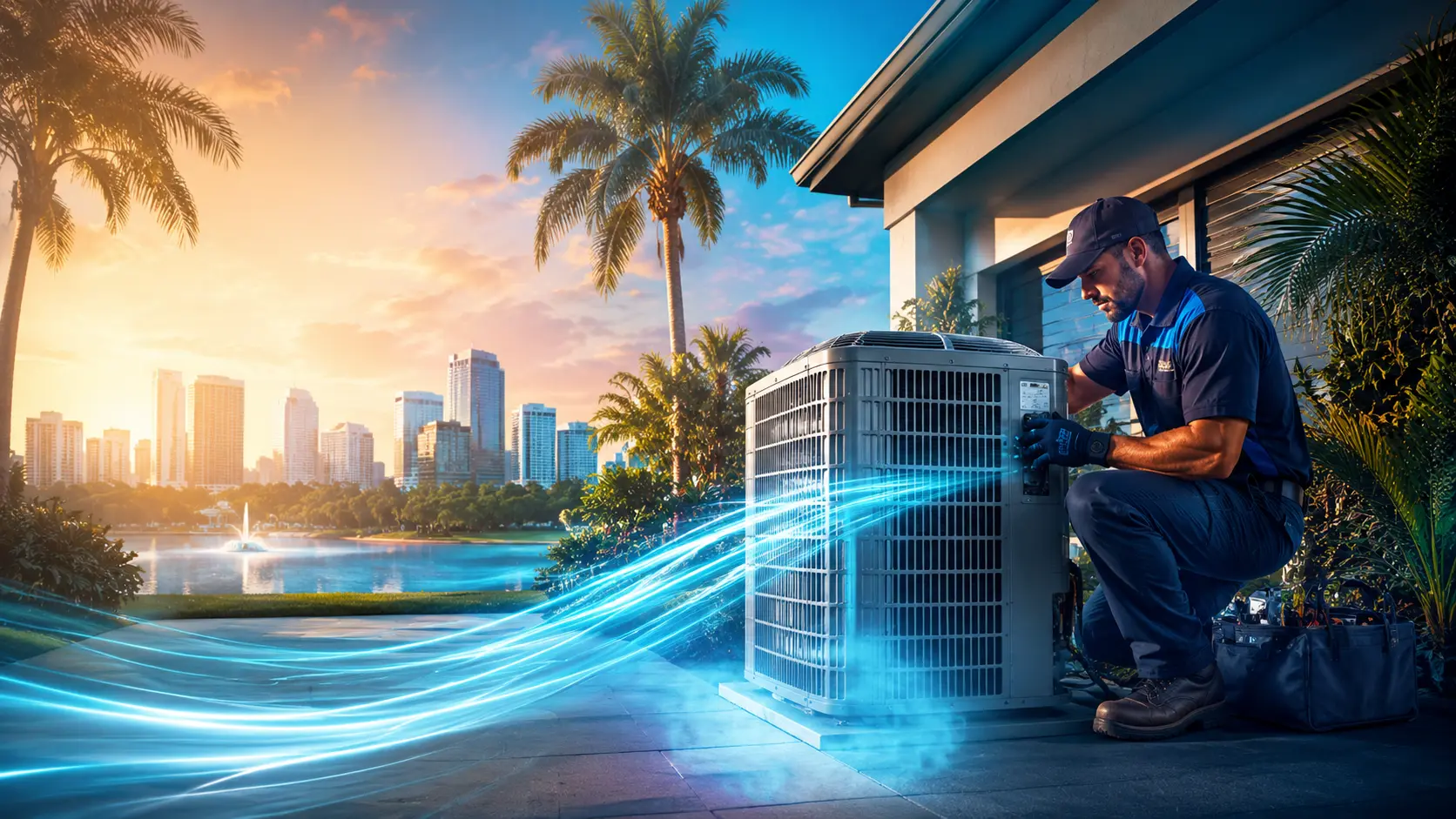
A repair visit is a sequence, not a single action. It starts with the symptom the homeowner describes, moves through verification at the thermostat and equipment, and narrows toward a specific component through electrical, airflow, and refrigerant measurements. The point of that sequence is to separate the failure from the cause, because those are frequently different things.
A blown capacitor, for example, is a failure. A condenser fan motor drawing high amperage because its bearings are dry is the cause that will destroy the next capacitor too. Repairs that only address the visible failure tend to bring the technician back within a season, which is why the diagnostic step deserves as much attention as the part swap.
Most residential repairs in Orlando fall into a short list of categories: electrical components in the outdoor unit, control and thermostat issues, refrigerant circuit problems, airflow restriction, condensate drainage, and compressor performance. Recognizing which category a symptom belongs to is the fastest way to shorten the visit.
Components That Fail Most Often Here
Central Florida run hours concentrate wear in specific places. The components below account for a large share of residential cooling calls in the Orlando area.
- Run capacitors, which weaken gradually and then fail suddenly, usually during peak load.
- Contactors, whose contacts pit and burn from thousands of switching cycles across a long cooling season.
- Condenser fan motors, which run in direct sun and high ambient temperatures for most of the year.
- Blower motors and blower wheels, which collect debris and lose airflow long before they stop turning.
- Condensate drains and float switches, loaded continuously by humidity removal.
- Refrigerant circuit joints and coil tubing, where small leaks develop over years of thermal cycling.
- Thermostats and low-voltage wiring, especially after equipment changes or DIY replacements.
How a Diagnosis Narrows Down
The first question is whether the system is receiving and responding to a call for cooling. If the thermostat is powered, set to cool, and the setpoint is below room temperature, the call should reach the equipment. If nothing responds at all, control power, breakers, float switches, and the transformer come first.
If the indoor blower runs but the outdoor unit is silent, attention moves to the contactor, capacitor, compressor and fan motor windings, and the pressure safety controls. If both units run and the air still is not cold, measurements move to refrigerant pressures, superheat and subcooling, temperature split across the coil, and airflow.
Intermittent problems are the hardest category. A system that fails only in the afternoon, or only after several hours of runtime, points toward heat-related electrical faults, marginal charge, or a safety control that opens and resets. Those cases benefit from operating the system under load rather than a quick check on a cool morning.
Repair Cost Factors
Repair pricing follows the part, the labor, and the conditions around the equipment. A capacitor replacement is a small job. A compressor replacement on a system with an obsolete refrigerant is a major one, and the gap between them is why a single quoted number rarely means much before diagnosis.
Accessibility matters more than homeowners expect. An air handler in a tight attic in July costs more in labor than the same unit in a garage closet. Warranty status matters too: a compressor still covered by a manufacturer parts warranty changes the decision entirely.
- The specific failed component and its availability
- Refrigerant type and the quantity required
- Diagnostic time, especially for intermittent faults and leak searches
- Equipment location and access difficulty
- Whether related conditions need correction to prevent repeat failure
- Remaining manufacturer parts warranty coverage
When Repair Stops Making Sense
Repair remains reasonable when the system is reasonably young, the failure is isolated, and the equipment cools well when it runs. The calculation shifts when the repair is large relative to replacement cost, when the system has needed multiple repairs in consecutive seasons, or when it no longer holds setpoint on hot afternoons even in good condition.
Age interacts with refrigerant type. Systems using older refrigerants can face higher material costs for any repair that opens the sealed circuit, which changes the math on leak repairs and compressor work specifically.
Answers
Frequently Asked Questions
How long does an AC repair take?
Many common repairs, such as replacing a capacitor, contactor, or clearing a condensate drain, are completed within a single visit. Repairs involving refrigerant leak searches, coil replacement, or compressor work take longer and may require a return visit once parts are sourced.
Should I run my AC while waiting for repair?
If the system is frozen, tripping a breaker repeatedly, making grinding noises, or leaking water near electrical components, it is better to shut it off. Running through those conditions can turn a moderate repair into a larger one.
Why did my AC fail again after a repair?
Repeat failures usually mean the underlying cause was not corrected. A failing motor keeps destroying capacitors, restricted airflow keeps refreezing a coil, and an unrepaired leak keeps draining charge. Ask which condition caused the part to fail, not just which part was replaced.
Can I replace an AC capacitor myself?
Capacitors store a charge even after power is removed and can be hazardous to handle without proper discharge and testing. Beyond the safety issue, replacing a capacitor without checking motor amperage often means replacing it again soon.
Does a repair restore full efficiency?
A correct repair restores the system to its own operating condition, but it does not change the equipment's design efficiency or reverse general wear. Airflow correction and proper charge often produce the largest noticeable improvement.
Related Pages
Discuss Your AC Problem
Describe what your system is doing and get repair information for your Orlando home.